Struggling to keep customers happy? Addressing their pain points is the key.
Customer pain points – pricing issues, slow processes, poor support, or inefficiencies – can cost you sales and loyalty. This guide helps SMEs identify and resolve these challenges step-by-step. Here’s the process:
- Gather Data: Analyze customer feedback, surveys, and metrics to uncover recurring frustrations.
- Engage Teams: Sales and support teams hold valuable insights into customer struggles.
- Map the Journey: Visualize every touchpoint to identify where problems arise.
- Prioritize Fixes: Focus on high-impact, low-effort solutions first.
- Test and Improve: Roll out changes in small steps and refine them based on results.
- Track Progress: Use KPIs like CSAT or NPS to measure success and stay aligned with customer needs.
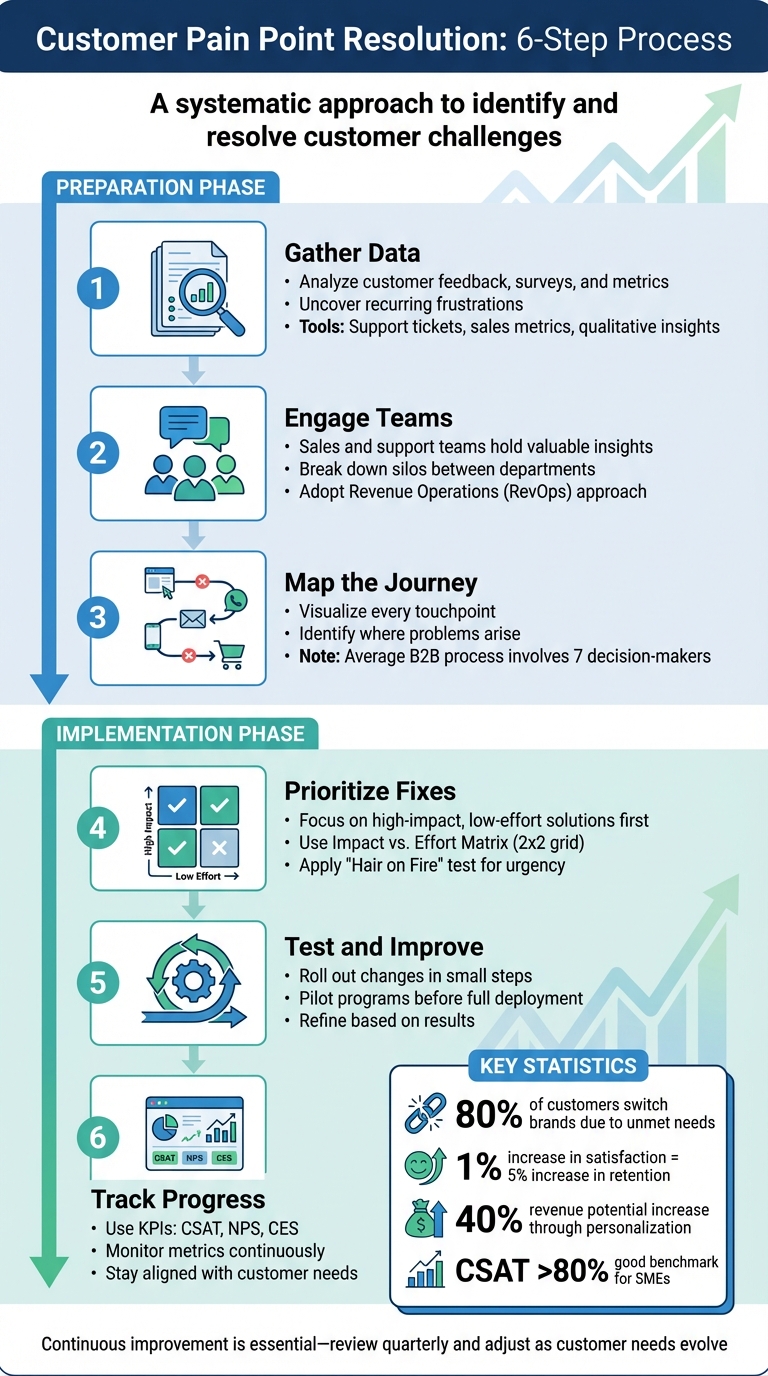
6-Step Customer Pain Point Resolution Process for SMEs
How to identify and tackle key customer pain points | Zendesk
sbb-itb-c53a83b
Preparation: Getting Started
Before diving into solutions, it’s crucial to lay the groundwork. Start by gathering data, working closely with your teams, and mapping out the customer journey. Skipping this step can mean wasting time solving the wrong problems. The aim is to clearly identify where your customers face challenges and determine which issues need your immediate focus.
Review Your Customer Data
Pull together data from all your available sources to uncover recurring patterns. For example, support tickets can highlight common complaints like delayed responses or confusing checkout procedures. Meanwhile, sales metrics can reveal where potential buyers drop off in the funnel or the objections your sales team frequently encounters. These gaps between initial interest and closed deals often signal problems in how you qualify leads or communicate your value.
Don’t stop at numbers – add qualitative insights from surveys, social media, or direct customer feedback. Why? Because two customers abandoning their carts might look the same in your data, but one might leave due to pricing concerns, while the other might be frustrated by unclear shipping costs. Both are lost sales, but they require different solutions.
Tools like Sisense can help by consolidating data from multiple sources into a single dashboard. This gives you a more complete picture rather than scattered insights. To ensure accuracy, cross-check what the data tells you with real-world observations from your frontline teams.
Speaking of teams, their input is invaluable.
Involve Your Teams
Your sales and support teams are on the front lines, witnessing customer frustrations in real time. Regular meetings with these teams can uncover issues that might not yet show up in your reports. For instance, they might notice customers frequently asking the same questions or struggling at specific stages of your process.
As Mario Peshev, CEO and Operator, explains:
"The most impactful results are seen in complex workflows with multiple people and 10+ steps, where an existing automation (deterministic) is tied to one or two non-deterministic steps via language models".
Operational improvements often emerge in these complex, multi-step workflows. To make meaningful progress, break down silos between departments. When sales, support, and marketing operate in isolation, they only see fragments of the customer experience. Adopting a Revenue Operations (RevOps) approach can unify these teams, creating shared data environments and fostering regular cross-team discussions.
Equip your teams with tools that encourage collaboration. For example, integrated CRM systems, shared documentation platforms, and AI-powered analysis tools can help everyone stay aligned. If your support team logs a recurring issue, your product team should be able to access that information immediately and understand its context.
Once you’ve aligned data and team insights, it’s time to map the customer journey.
Map Your Customer Journey
Mapping out the customer journey allows you to visualize every interaction, from initial discovery to post-purchase, and pinpoint where friction occurs. This visual representation doesn’t just show where problems exist – it helps you understand why they happen.
Break the journey into specific touchpoints, such as website visits, email communications, phone calls, checkout processes, and support requests. At each point, ask yourself: What is the customer trying to achieve? What could be slowing them down or causing confusion? Keep in mind that the average B2B purchasing process involves about seven decision-makers, so your map should account for varying perspectives and concerns.
Categorize the pain points you discover by their severity and scope. Some issues might disrupt a single interaction, like a slow-loading webpage, while others, such as inconsistent service quality across channels, can impact the entire customer relationship. Prioritizing these issues helps you focus on the most pressing problems while understanding how improvements in one area might enhance the overall experience.
Checklist for Fixing Customer Pain Points
Now that you’ve collected data, aligned your teams, and mapped out the customer journey, it’s time to tackle those pain points head-on. This checklist walks you through each step to resolve issues thoroughly, avoiding surface-level fixes.
Step 1: Gather Customer Feedback
Start by reaching out to your customers directly. Use open-ended survey questions like, "What was the biggest challenge you faced during the sales process?" to let them voice their concerns in their own words. This approach avoids steering them toward pre-set answers.
Go beyond surveys – host focus groups and keep an eye on community forums where customers freely discuss their experiences.
"As a Director of Customer Experience at Zendesk, I’ve found that it’s imperative to provide scalable means for customers to share pain points to collect product feedback".
Don’t forget third-party platforms like Trustpilot, Reddit, or niche forums. These often reveal honest feedback customers might hesitate to share directly. Behavioral clues are also key. For example, repeated visits to your pricing page without conversions or abandoned demos can indicate hidden frustrations. Even a simple question in your welcome email, like "What’s your biggest challenge with our service?", can uncover valuable insights.
Step 2: Talk to Your Internal Teams
Your sales and support teams interact with customers daily, making them a goldmine for understanding frustrations. Regular debriefs with these teams can help you spot patterns and identify recurring issues before they show up in metrics.
Use collaborative tools to brainstorm solutions in real time. When teams work together instead of in silos, they can connect the dots and provide a clearer picture of customer pain points.
Step 3: Review Your Metrics
Data complements customer feedback by highlighting trends. Metrics like churn rates, support resolution times, and ticket volume can shed light on problem areas. For example, if 90% of customers expect an "immediate" response to service questions, but your average response time is hours, you’ve found a critical gap.
Look for friction signals, such as frequent revisits to your pricing page without conversions. With 80% of customers switching to competitors due to unmet needs, even small improvements in these areas can boost retention. Cross-check these findings with customer feedback. If surveys mention a confusing checkout process and metrics show high cart abandonment, you’ve confirmed the issue and its priority.
Step 4: Deploy Quick Fixes
Once you’ve identified the key pain points, focus on simple solutions that can make an immediate difference. For example:
- If customers ask the same questions repeatedly, set up a chatbot or self-service knowledge base.
- For long wait times, add queue management tools like callback options or automated updates.
- If unclear return policies lead to abandoned purchases, create a returns portal with pre-paid labels and easy refund options.
Small changes can have a big impact. For every 1% increase in customer satisfaction, retention rates can rise by 5%. Focus on fixing high-impact areas instead of trying to overhaul everything at once.
Step 5: Test and Adjust
Before rolling out changes across the board, test them in a controlled environment. Pilot programs allow you to observe real-time interactions and address any unintended issues before scaling up.
Take an agile approach, making continuous improvements based on feedback. Use surveys and feedback forms immediately after the pilot to identify lingering pain points. Organize test results into categories like usability, reliability, and support to prioritize adjustments.
Set up feedback loops to monitor the impact of your changes. Use analytics to confirm they’re working as intended, and involve cross-functional teams to evaluate scalability. Tools like root cause analysis diagrams can ensure you’re addressing the root of the problem rather than just the symptoms.
Step 6: Expand and Standardize
Once your fixes are tested and refined, standardize the successful solutions. Document everything – implementation steps, expected outcomes, and performance metrics – so these improvements become part of your standard operations rather than one-off fixes.
Make sure your solutions are sustainable. Personalization, for instance, can boost revenue potential by up to 40%, while leveraging customer insights can improve marketing efficiency by 20%. This data-driven approach is a cornerstone of effective marketing strategies. Train your teams on new processes, provide the right tools, and monitor social media and reviews to catch any unintended consequences early. Build mechanisms for continuous improvement to adapt as customer needs evolve.
How to Prioritize Pain Points
To effectively address customer pain points, focus on those that deliver the greatest impact. For small and medium-sized enterprises (SMEs), this approach is crucial since resources are often limited. The aim is to tackle problems that produce meaningful results without overwhelming your team.
Start by categorizing pain points into four types: Financial, Productivity, Process, or Support. Once categorized, apply the "Hair on Fire" test. This test gauges how urgent a problem is – would it compel customers to switch immediately? As PainOnSocial explains:
"The best opportunities are ‘hair on fire’ problems – situations where the pain is so intense that people are actively seeking solutions right now, not someday in the future".
If a problem is merely a "nice to have", it should be deprioritized.
Ranking Pain Points
Use a weighted scoring system to rank pain points. Assign scores based on four criteria:
- Frequency (25%)
- Intensity (30%)
- Willingness to Pay (25%)
- Feasibility (20%)
Multiply these scores to calculate a weighted total. For instance, if manual data entry scores 9 for frequency, 8 for intensity, 7 for willingness to pay, and 9 for feasibility, the weighted score would be 8.2. This score highlights it as a top priority.
Next, map your top-scoring pain points on an Impact vs. Effort Matrix (2×2 grid). Focus first on high-impact, low-effort issues – these are your quick wins. High-impact, high-effort items should follow if they provide a competitive edge. By addressing these quick wins, you establish a strong foundation for improving the customer experience.
Example Solutions by Pain Point Type
| Pain Point Type | Common Solution | Effort Required | Expected Result |
|---|---|---|---|
| Financial | Cost-saving automation or tiered pricing | Medium to High | Direct ROI and measurable savings |
| Productivity | Workflow automation for 10+ step processes | Medium to High | Significant time savings; fewer errors |
| Process | Standardizing fragmented internal tasks | High | Better operational efficiency |
| Support | Self-service portals or improved documentation | Low to Medium | Reduced churn; higher satisfaction |
Balancing Capacity and Effort
SMEs operate with limited capacity, so it’s essential to evaluate your team’s ability to implement solutions. Mario Peshev, CEO of Growth Shuttle, highlights this challenge:
"A small team only employs so many decision-makers and managers capable of allocating a good chunk of their time to something new that may or may not work".
When possible, prioritize automated solutions over those that require ongoing manual effort. This ensures that your team can stay focused on sustainable improvements.
Tracking and Ongoing Improvement
Once you’ve addressed your prioritized fixes, the next step is to keep an eye on the outcomes. Continuous tracking isn’t just about monitoring progress – it’s about staying in sync with ever-changing customer needs and expectations.
Resolving customer pain points is not a one-and-done task. As customers’ needs shift and new touchpoints emerge, maintaining a system of regular monitoring and adjustments is crucial.
Create KPI Dashboards
A dashboard is a great way to keep track of key metrics that reflect customer satisfaction and operational efficiency. Focus on metrics like Customer Satisfaction Score (CSAT), Net Promoter Score (NPS), and Customer Effort Score (CES) to understand how your customers feel about your brand and their loyalty levels. Operational metrics, such as First Response Time and Resolution Time, can help you measure how quickly and effectively your team resolves issues.
Don’t overlook behavioral signals like cart abandonment rates or failed searches – they can reveal friction points that might otherwise go unnoticed. For example, a CSAT score above 80% is often a good benchmark for small and medium-sized enterprises (SMEs). Research shows that even a 1% increase in customer satisfaction can boost retention rates by 5%.
To make this process easier, use helpdesk tools to consolidate these metrics into a single, real-time dashboard. Segment the data by factors like demographics, location, or purchasing behavior to uncover trends and patterns that might require attention. Then, take it a step further by linking these insights to your customer journey map for actionable results.
Review Your Customer Journey Regularly
Your customer journey map isn’t a static document – it should evolve over time. Plan quarterly reviews, ideally during slower business periods when your team has the capacity for in-depth analysis. Companies that actively use customer journey maps are twice as likely to outperform their competitors.
During these reviews, document any deviations from the "ideal" journey to address them quickly. Pay close attention to your Customer Effort Score (CES) – a rise in effort required to complete tasks should prompt an immediate review of your journey map. Sales and Support teams are invaluable here; their day-to-day interactions with customers can reveal where the actual experience falls short of expectations.
If you hit a wall during these internal reviews, it might be time to bring in outside expertise.
Get Expert Help When Needed
Sometimes, solving certain pain points requires specialized knowledge. For complex challenges or strategic guidance, consulting experts can make all the difference. Growth Shuttle offers advisory services tailored to SMEs, focusing on operational efficiency and workflow management. Their plans start at $600/month and include monthly strategy sessions, making them a good fit for CEOs managing teams of 15–40 people. Whether it’s improving processes or refining go-to-market strategies, their expertise can help you move forward.
"Customer pain points manifest culturally and via a team’s ability to deliver. A good operation should have awareness of these problems and contingencies to maneuver around them".
When internal efforts aren’t enough, having access to experienced advisors can provide the clarity and direction needed to tackle more intricate challenges.
Conclusion
Addressing customer pain points isn’t just a one-time task – it’s an ongoing process that directly impacts your business’s success. Consider this: 80% of customers switch brands because their needs aren’t met, but even a small 1% uptick in satisfaction can lead to a 5% increase in retention. That’s a powerful incentive to get it right.
The structured approach shared here – from gathering customer feedback to standardizing solutions – offers a clear path to tackle these challenges. By applying this framework, you’re not just solving problems; you’re creating a foundation for a more reliable and rewarding customer experience. Without such a system, miscommunication and inefficiencies could cost your business dearly.
For growing SMEs, the shift from reactive fixes to proactive strategies is key. Aligning marketing, sales, customer experience, and product teams creates a unified front to address customer needs effectively. As Mario Peshev, CEO of DevriX, wisely states:
"A business cannot scale if the founders work in the business instead of determining and setting the direction for the entire organization".
Smaller teams, in particular, have the advantage of agility. Use your KPI dashboards and conduct regular reviews of the customer journey to ensure ongoing improvement. And when internal resources reach their limits, don’t hesitate to bring in expert advisors to refine your strategy and take your efforts to the next level.
FAQs
What’s the fastest way to find our biggest customer pain points?
The fastest way to pinpoint major customer pain points is to gather direct feedback, tap into insights from your sales and support teams, and evaluate customer data. These strategies offer quick and actionable insights into the hurdles your customers are experiencing. By addressing these challenges promptly, you can make a noticeable difference in customer satisfaction and loyalty.
How do we prioritize pain points when our team is small?
When your team is small, it’s crucial to tackle the pain points that have the biggest impact on your customers and how smoothly your business runs. Focus on the most pressing and frequent issues – especially those that frustrate customers or hurt conversions. Choose problems that your team can realistically handle with the resources you have and that offer the greatest payoff for your efforts. This way, you can make real progress without overwhelming your team.
Which KPIs should we track to prove the fixes are working?
To ensure the fixes are working, keep an eye on key metrics such as customer satisfaction, retention rates, response times, and resolution times. These indicators provide a clear picture of how well customer experience has improved and whether pain points are being addressed effectively.
Related Blog Posts
The post Customer Pain Point Resolution: Checklist for SMEs appeared first on Growth Shuttle.